
Introduction to the Indian Education Sector
Starting a school in India is a dream for many people who want to contribute to education and create a better future for children. However, when people start searching for how to open a school in India, they often feel confused about legal approvals, land requirements, school registration, and government rules.
India’s education sector is growing rapidly. Parents today are looking for better schools, modern learning methods, and safe environments for students. This has increased the demand for quality schools in both cities and small towns.
However, opening a school in India is not just about constructing a building. It requires proper planning, registration, infrastructure, qualified teachers, and recognition from education authorities. This guide explains the complete step-by-step process in simple language for 2026.
Types of Schools in India
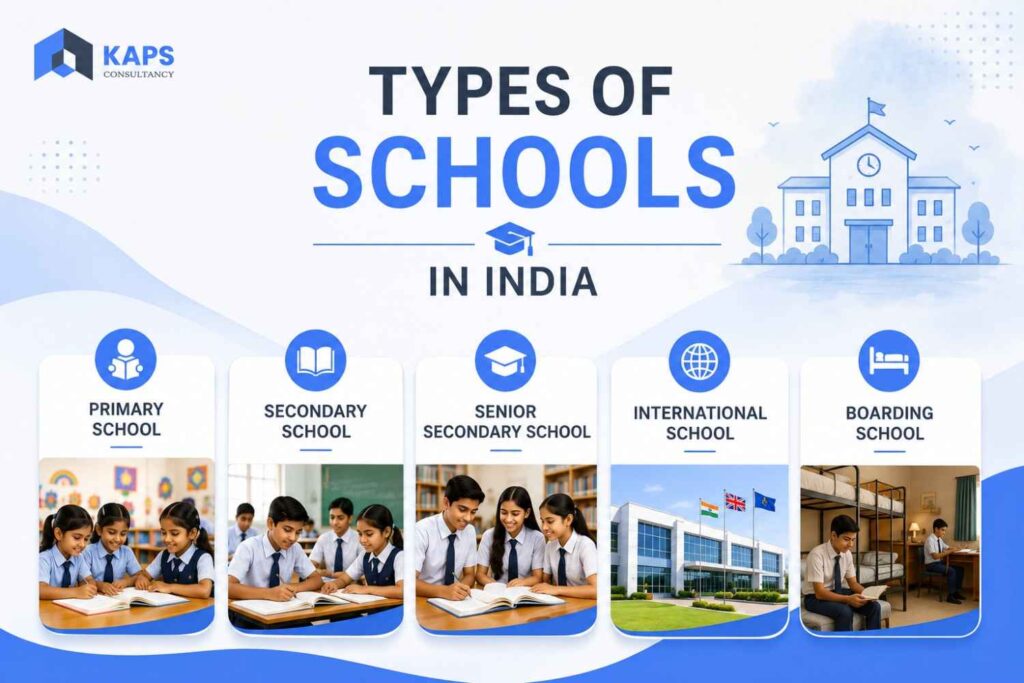
Before starting the process, you must decide what type of school you want to establish.
Primary School
Primary schools usually include Nursery to Class 5. Many people search for how to open primary school in India because these schools need lower investment compared to senior secondary schools.
Secondary School
These schools generally cover Classes 6 to 10 and focus on academic foundation and board preparation.
Senior Secondary School
These schools include Classes 11 and 12 with streams like Science, Commerce, and Arts.
International School
International schools follow global curriculums such as IB or Cambridge and usually require higher investment.
Boarding School
Boarding schools provide hostel facilities along with education and extracurricular activities.
The school education system in India includes different boards, teaching methods, and state-specific regulations.
Legal Requirements & Registrations
Understanding legal requirements is the first important step in how to establish a school in India.
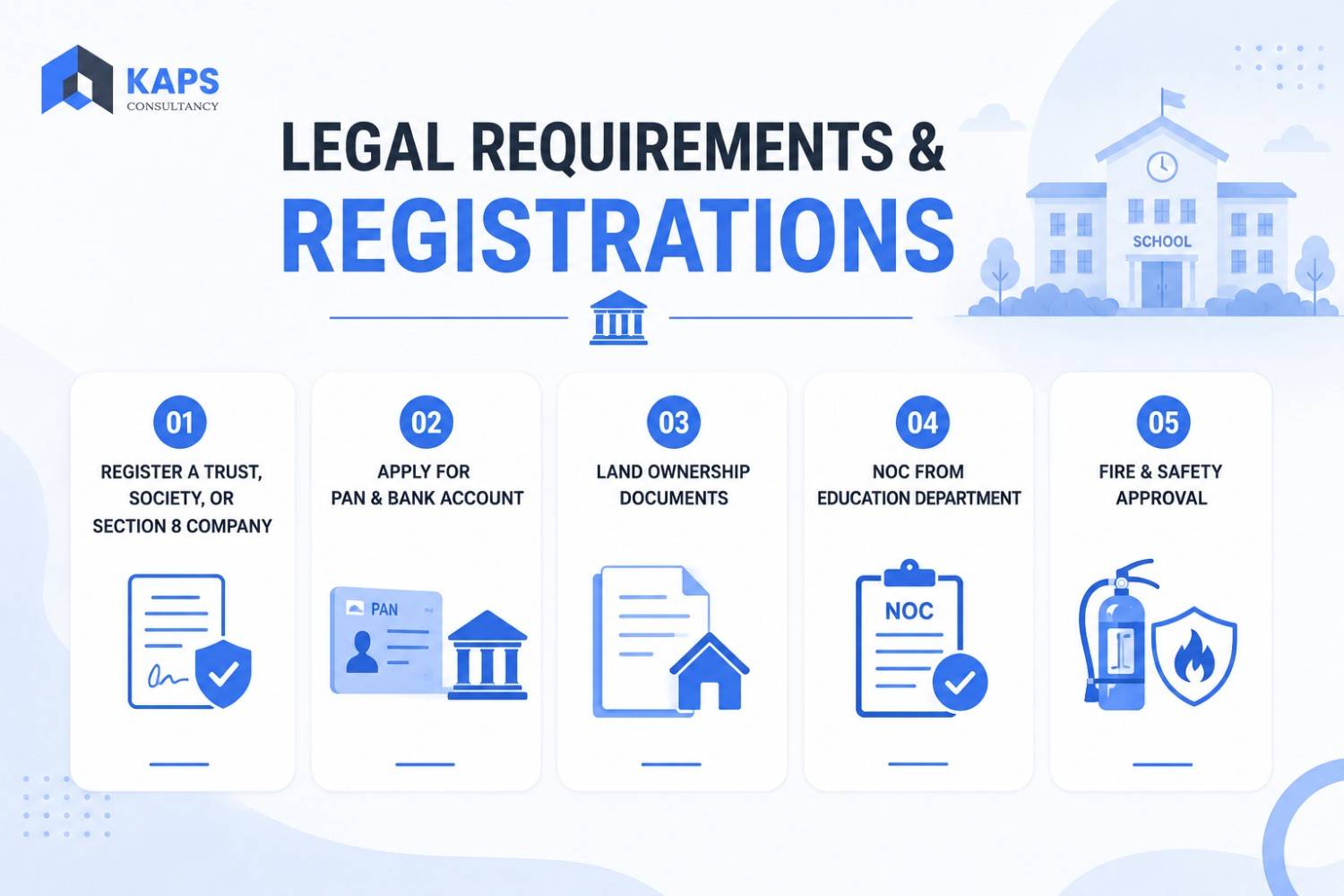
Register a Trust, Society, or Section 8 Company
Schools in India are generally operated under:
- Educational Trust
- Society Registration
- Section 8 Company
This registration gives legal identity to the institution.
Apply for PAN & Bank Account
After registration, you need:
- PAN Card
- TAN Registration
- Official bank account
Land Ownership Documents
You must have:
- Sale deed or lease agreement
- Land use approval
- Building plan approval
NOC from Education Department
Most states require a No Objection Certificate before school operations begin.
Fire & Safety Approval
Schools must follow safety rules such as:
- Emergency exits
- Fire extinguishers
- Student safety systems
Land & Infrastructure Requirements
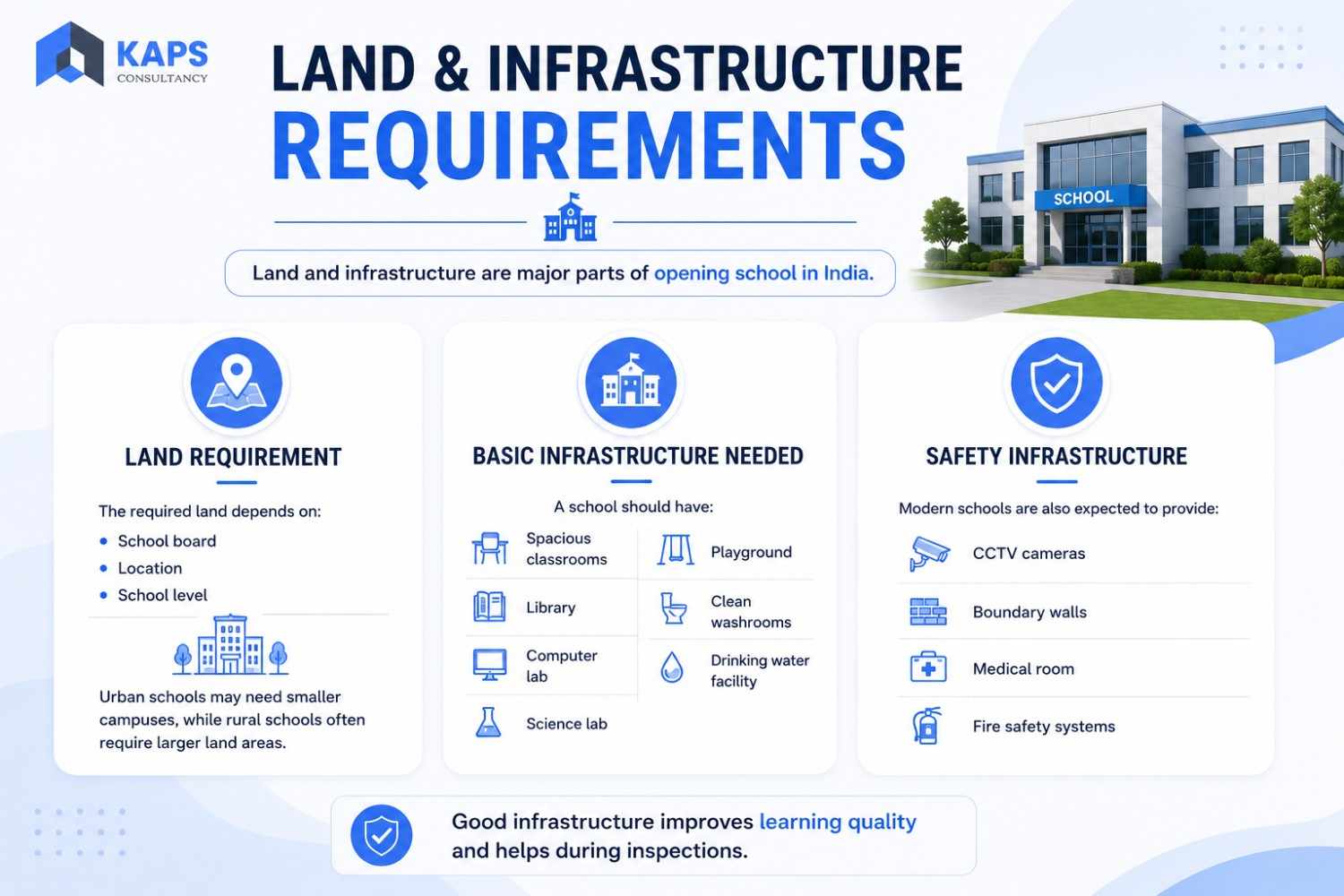
Land and infrastructure are major parts of opening school in India.
Land Requirement
The required land depends on:
- School board
- Location
- School level
Urban schools may need smaller campuses, while rural schools often require larger land areas.
Basic Infrastructure Needed
A school should have:
- Spacious classrooms
- Library
- Computer lab
- Science lab
- Playground
- Clean washrooms
- Drinking water facility
Safety Infrastructure
Modern schools are also expected to provide:
- CCTV cameras
- Boundary walls
- Medical room
- Fire safety systems
Good infrastructure improves learning quality and helps during inspections.
CBSE / ICSE / State Board Affiliation Process
Board affiliation is one of the most important parts of how to open a school in India.
Aspect | CBSE | ICSE |
Curriculum Style | National Level | Detailed & Broad |
Popularity | Very High | Moderate |
Competitive Exam Support | Strong | Good |
Fees Structure | Moderate | Higher |
Approval Process | Structured | Detailed |
CBSE Affiliation Process
For CBSE affiliation, schools must:
Complete legal registration
Develop required infrastructure
Recruit qualified teachers
Obtain state NOC
Apply through CBSE portal
ICSE Affiliation
ICSE schools must meet infrastructure, academic, and staff requirements set by the council.
State Board Recognition
State board schools generally have lower setup costs and simpler procedures.
Investment & Cost Breakdown
The investment required for how to establish a school in India depends on location, school size, and board type.
Requirement | Estimated Cost |
Land Purchase | ₹20 Lakhs – ₹5 Crores |
Building Construction | ₹30 Lakhs – ₹10 Crores |
Furniture & Equipment | ₹10 Lakhs – ₹1 Crore |
Licenses & Registrations | ₹2 Lakhs – ₹15 Lakhs |
Teacher Salaries | Monthly Expense |
Marketing & Branding | ₹1 Lakh – ₹10 Lakhs |
Schools in metro cities usually require higher budgets compared to schools in smaller towns.
Teacher Recruitment Requirements
Teachers are the backbone of the school education system in India.
Basic Qualifications
Most schools require:
- Graduation degree
- B.Ed qualification
- TET qualification (where applicable)
Staff Needed in a School
Schools usually recruit:
- Principal
- Subject teachers
- Academic coordinators
- Librarian
- Accountant
- Administrative staff
Qualified teachers improve educational quality and student performance.
Government Rules & Permissions
Several approvals are necessary for opening school in India.
Important Permissions
- Building safety certificate
- Fire NOC
- Health department approval
- Municipal approval
- Education department recognition
RTE Compliance
Schools must follow Right to Education (RTE) guidelines issued by the government.
Environmental Requirements
Many states now encourage:
- Waste management systems
- Green campuses
- Proper sanitation
Ignoring government rules can delay approvals or create legal problems later.
Challenges While Opening a School
Starting a school can be challenging, especially for first-time investors.
Common Challenges
- Delayed government approvals
- High construction costs
- Difficulty in board affiliation
- Teacher recruitment issues
- Documentation errors
Financial Challenges
New schools may initially face:
- Low admissions
- High operational expenses
- Salary management issues
Proper planning helps reduce these risks.
How Educational Consultants Help
Educational consultants help institutions manage the school setup process more efficiently.
Common Areas of Support
- Documentation guidance
- Board affiliation support
- Infrastructure planning
- Government compliance assistance
- Recruitment planning
Kaps consultancy Services provides guidance related to educational consultancy and school establishment procedures in India.
Professional guidance often helps schools avoid delays and documentation mistakes.
Why Opening a School Matters
Schools are important for community development and future growth.
Benefits of Opening a School
- Creates educational opportunities
- Generates employment
- Improves literacy rates
- Supports local development
A good school can positively impact generations of students.
Infinity Learn Inspired School Case Study
Situation
A group of education investors in Jaipur planned to establish a modern CBSE primary school inspired by the digital learning approach of Infinity Learn. Their vision was to create a school that combined traditional classroom education with smart learning systems and technology-based teaching methods.
During the initial setup stage, the institution faced several operational and approval-related challenges:
- Incomplete land and building documentation
- Delays in municipal approvals
- Lack of understanding about CBSE affiliation requirements
- Poor infrastructure planning
- Difficulty in recruiting qualified teachers for digital learning classrooms
Because of these issues, the school approval process became slow, and admissions could not begin on time.
Action
To organize the setup process professionally, the investors worked with Kaps Consultancy Services for educational consultancy and school establishment guidance.
Documentation & Compliance Management
Kaps Consultancy Services helped the institution complete and organize:
- Land ownership verification
- Building plan approvals
- Fire and safety documentation
- Municipal compliance paperwork
- Education department requirements
This reduced delays caused by incomplete approvals and documentation errors.
Infrastructure Planning
The consultancy team guided the school management in developing infrastructure according to modern CBSE school standards, including:
- Smart classrooms
- Computer learning labs
- Library and activity areas
- CCTV security systems
- Student safety infrastructure
- Clean washrooms and drinking water facilities
The planning approach was inspired by technology-focused learning environments similar to Infinity Learn.
Teacher Recruitment & Academic Structure
The institution also improved its teacher recruitment system by hiring:
- B.Ed qualified teachers
- Digital learning coordinators
- Academic support staff
Training sessions were introduced to help teachers adapt to:
- Smart classroom systems
- Interactive learning methods
- Student engagement activities
Affiliation Guidance
Kaps Consultancy Services further supported the institution in understanding:
- CBSE affiliation requirements
- Student-teacher ratio guidelines
- School inspection preparation
- Government safety compliance standards
This helped the management prepare confidently for approvals and future expansion.
Result
Within one year:
- The institution successfully received approval for primary school operations
- Admissions started smoothly
- Parent trust increased because of better infrastructure and digital learning systems
- Student inquiries increased significantly
The institution later expanded from primary level to middle school level and introduced:
- Smart digital classrooms
- Activity-based learning programs
- Online parent communication systems
- Technology-supported academic tracking
Today, the school operates as a growing educational institution combining traditional CBSE education with modern learning methods inspired by Infinity Learn.
This case study highlights how proper planning, infrastructure management, teacher recruitment, and consultancy support from Kaps Consultancy Services can help investors successfully establish and expand a modern school in India.
Conclusion
Understanding how to open a school in India requires careful planning, proper legal registration, infrastructure development, teacher recruitment, and board affiliation. Every step must follow government guidelines and education department standards.
As India’s education sector continues to grow, more investors and educational trusts are exploring opportunities to establish schools in cities and developing regions. With the right preparation and proper guidance, setting up a successful school becomes much easier.
For institutions looking for guidance related to educational consultancy, approvals, and school setup procedures, Kaps consultancy Services provides support for educational projects across India.