
Land for School Development in India
Discover how landowners and investors can explore school development opportunities through land leasing, strategic partnerships, joint development, and education investment planning for long-term institutional value.
Land for School Development in India: How Landowners and Investors Can Build Long-Term Value

Introduction
You spent years building an asset. But for many landowners, the next question is not simply what the property is worth today. It is what the property could become tomorrow.
For some suitable properties, land for school development in India can offer a different path: institutional use through leasing, partnership, joint development, or a new school project.
However, owning land does not automatically make it suitable for a school. Location, catchment potential, accessibility, land-use permissions, competition, development costs, and the proposed school model all need to be evaluated first.
This guide explains how landowners and investors can assess a school development opportunity, compare development models, understand their roles, and avoid common mistakes before committing land or capital.
Your Land Can Be More Than a Real Estate Asset
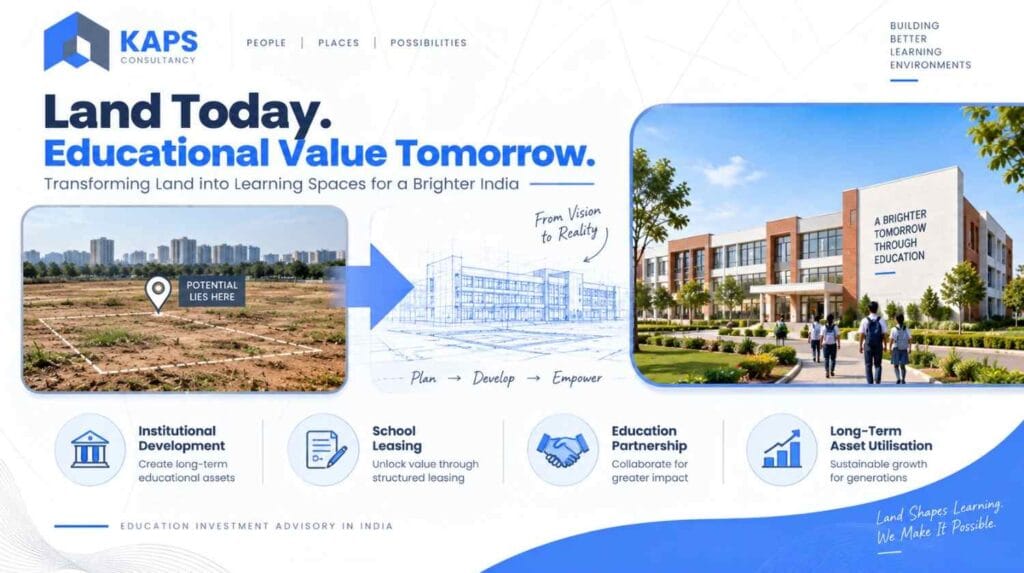
Land is often viewed through its current market value. For a landowner, however, its long-term value may also depend on how effectively the property can be utilised.
A suitable parcel may potentially support:
- Institutional development
- School leasing
- Education partnerships
- Joint development
- Long-term asset utilisation
- A new school project
- Strategic property investment
The key word is suitable.
Not every property should become a school. A successful education project needs the right location, market, infrastructure potential, legal position, and operating model.
For example, a large parcel located near growing residential communities may have a different potential from similarly sized land in an area with weak accessibility or limited student catchment.
The first step is therefore not construction. It is feasibility.
Why Landowners Are Exploring School Development Opportunities
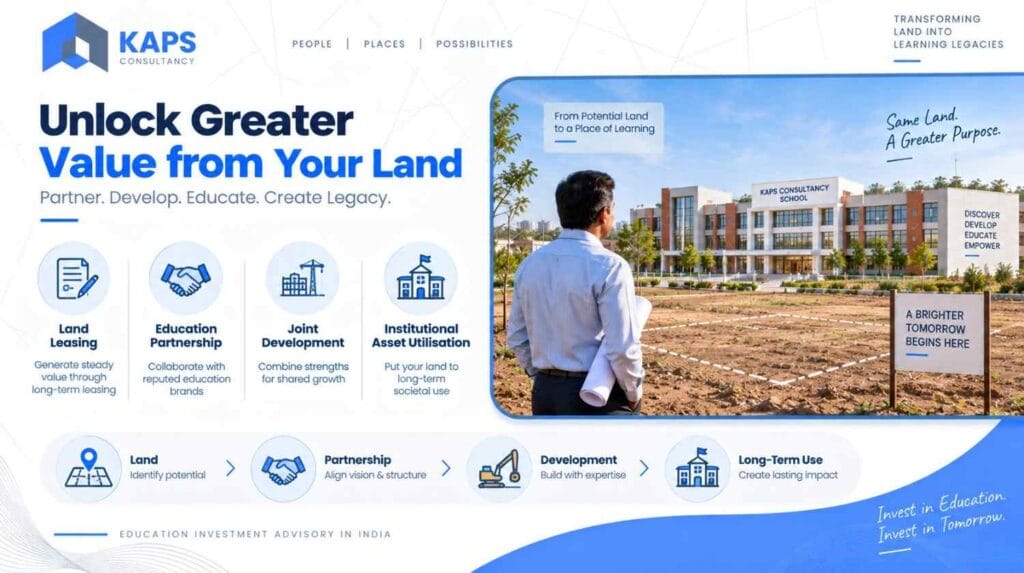
A landowner may have property that is valuable but underutilised. Instead of selling immediately, the owner may consider an institutional model that creates a longer-term relationship with an education operator or investor.
Potential approaches include:
- Long-term land leasing
- Partnership with an education brand
- Joint development
- Investor-landowner arrangements
- Institutional asset utilisation
KAPS Consultancy identifies leasing and asset utilisation as areas where suitable land can be structured for long-term institutional use, including leasing models and partnerships with educational organisations.
For some landowners, the motivation is financial. For others, it may include creating a long-term institutional asset or contributing to education infrastructure in a growing community.
The commercial structure should always be evaluated according to the land, project economics, responsibilities, legal terms, and intended school model.
Is Your Land Suitable for a School?
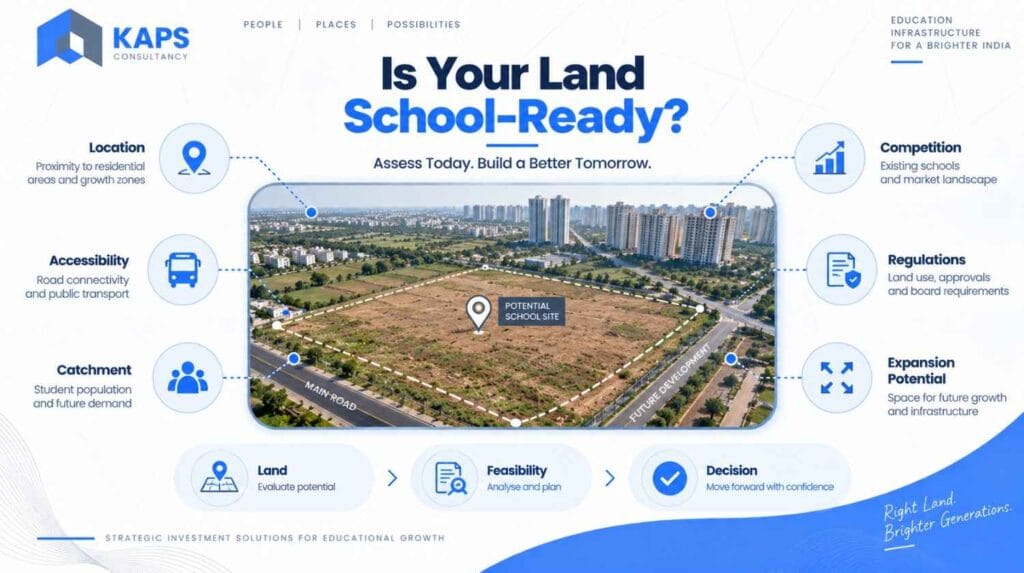
Land for School Development in India should be evaluated on more than size or market price. A proper assessment should consider location, catchment demand, accessibility, competition, legal status, land-use permissions, infrastructure feasibility, and future expansion potential.
1. Location and Accessibility
A school depends heavily on its surrounding population and daily accessibility.
Consider:
- Road connectivity
- Public transport availability
- Residential catchment
- Nearby housing projects
- New townships
- Population growth
- Future infrastructure development
- Distance from major residential clusters
A property surrounded by developing residential communities may deserve closer evaluation than an isolated parcel with limited access.
2. Student Catchment and Market Demand
The existence of land does not prove student demand.
Study the surrounding market:
- Number of existing schools
- School brands operating nearby
- Fee ranges
- Student capacity
- Parent preferences
- Residential growth
- Potential demand for a new school
Competition should not automatically disqualify a location. Instead, investors need to understand whether the proposed school can offer a clear positioning and sustainable operating model.
3. Land and Regulatory Feasibility
Land documents and applicable regulations require careful review before development.
For example, CBSE affiliation requirements include conditions concerning land, school buildings, playgrounds, boundaries, and other facilities. Current CBSE materials also show that land requirements can vary by location and applicable provisions.
Therefore, landowners should not rely on a generic assumption such as “more land means the project is approved.”
Check:
- Title and ownership
- Land-use permissions
- Applicable local regulations
- Access and road conditions
- Site constraints
- Infrastructure requirements
- Applicable school-board requirements
- Development and approval processes
4. Expansion Potential
A school is a long-term project. The initial campus plan should therefore be considered alongside future capacity.
The question is not only:
Can a school be built here?
It is also:
Can the proposed institution grow sustainably on this site?
Five School Development Models for Landowners
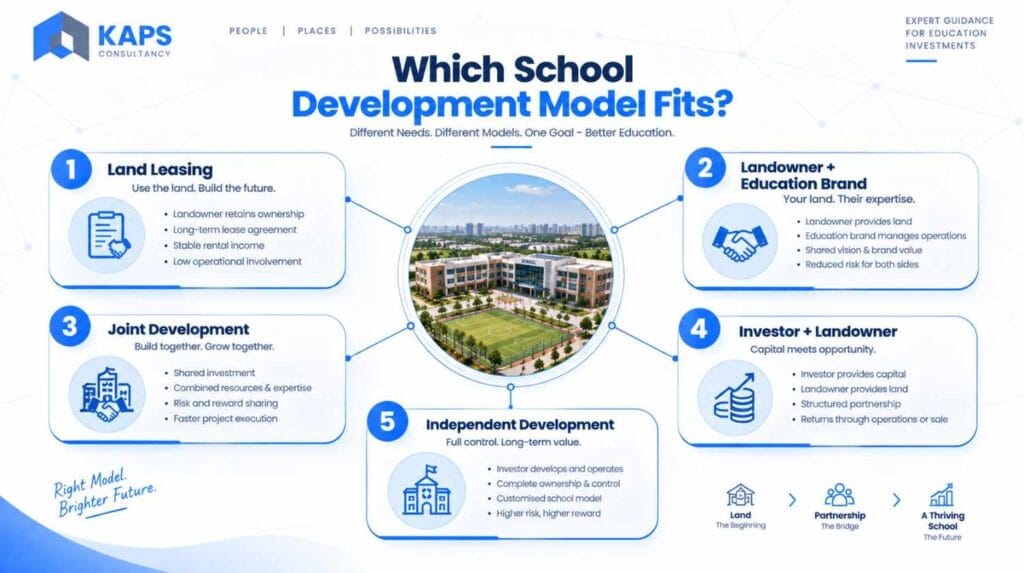
There is no single structure for every landowner. The appropriate model depends on the property, capital availability, education partner, project requirements, and commercial objectives.
1. Land Leasing Model
The landowner leases suitable property to an education operator, trust, society, or other eligible entity under agreed commercial and legal terms.
This can allow the landowner to retain ownership while creating a structured institutional use for the property.
2. Landowner + Education Brand Partnership
The landowner contributes the property while an education brand or operator contributes institutional expertise, systems, management capabilities, or brand strength.
Responsibilities, investment requirements, revenue arrangements, tenure, and exit provisions should be clearly documented.
3. Joint Development Model
The landowner and development or education partner participate in the project under an agreed structure.
This may involve shared investment, responsibilities, development rights, revenue arrangements, or ownership interests, depending on the legal and commercial structure.
4. Investor + Landowner Model
Here, the landowner contributes suitable property while an investor provides some or all of the required capital.
This structure can be relevant when the land is available but the owner does not want to fund the complete development.
5. Independent School Development
A landowner or investor may choose to develop and operate the project independently.
This provides greater control but also places greater responsibility on the project owner for feasibility, capital, approvals, infrastructure, staffing, operations, admissions, and long-term management.
What Investors Should Check Before Investing in a School Project
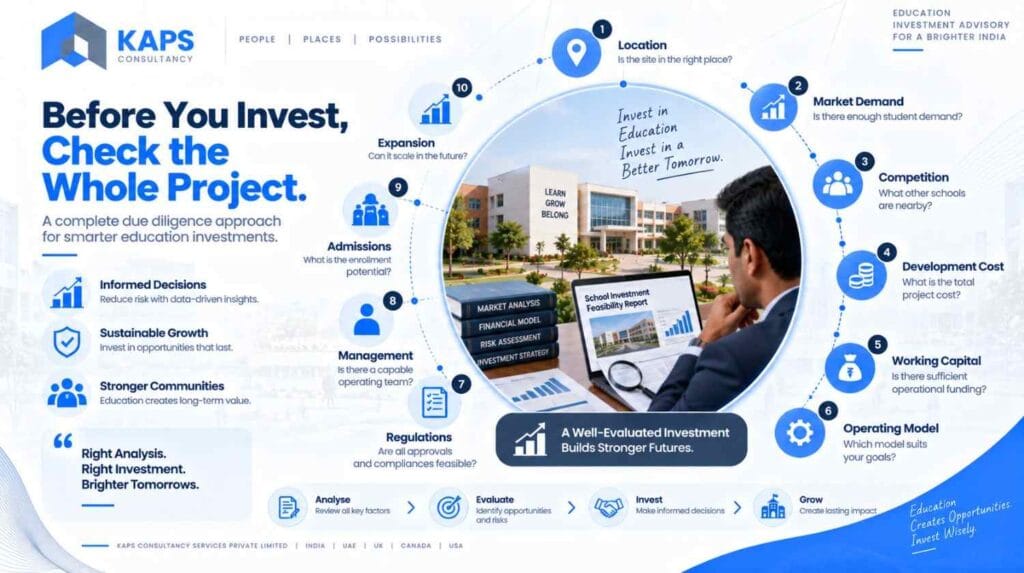
School investment opportunities in India should be evaluated as education businesses and institutional projects, not only as property transactions.
Before investing, examine:
- Location feasibility – Is the catchment strong enough?
- Market demand – Is there a genuine opportunity for the proposed school?
- Competition – Which schools already serve the area?
- Development cost – What will land development, construction, infrastructure, and equipment require?
- Working capital – Can the project support its early operating period?
- Operating model – Who will manage the school?
- Regulatory requirements – What approvals and standards apply?
- Management capability – Does the operating team have relevant experience?
- Admissions strategy – How will the institution attract and retain students?
- Expansion potential – Can the project scale over time?
KAPS Consultancy describes its Education Investment Advisory services around project evaluation, opportunity assessment, investment planning, and educational asset development.
A feasibility assessment should therefore happen before major financial commitments.
Landowner or Investor? Understand Your Role Before Starting

Landowner | Investor |
Owns the property | Provides capital |
Evaluates land potential | Evaluates project viability |
May lease the property | May invest in development |
May partner with an education operator | May partner with a landowner |
Focuses on asset utilisation | Focuses on investment structure |
Reviews lease or partnership terms | Reviews financial and operational requirements |
The two roles can overlap. A landowner can also invest capital, while an investor may own or acquire property.
The important point is to define who contributes what, who controls what, and who carries which responsibilities before entering an agreement.
What Makes School Property Investment Different From Normal Real Estate?
School development should not be treated as a simple:
Buy land → Build building → Generate income
The actual development journey is broader:
Land → Feasibility → Market Assessment → School Model → Investment Structure → Development → Operations → Admissions → Long-Term Growth
The property is only one component.
A school also requires an appropriate academic model, management structure, infrastructure, compliance planning, staffing, admissions strategy, and financial sustainability.
This is why education investment advisory and school development planning can be useful before construction begins.
Common Mistakes Landowners and Investors Should Avoid
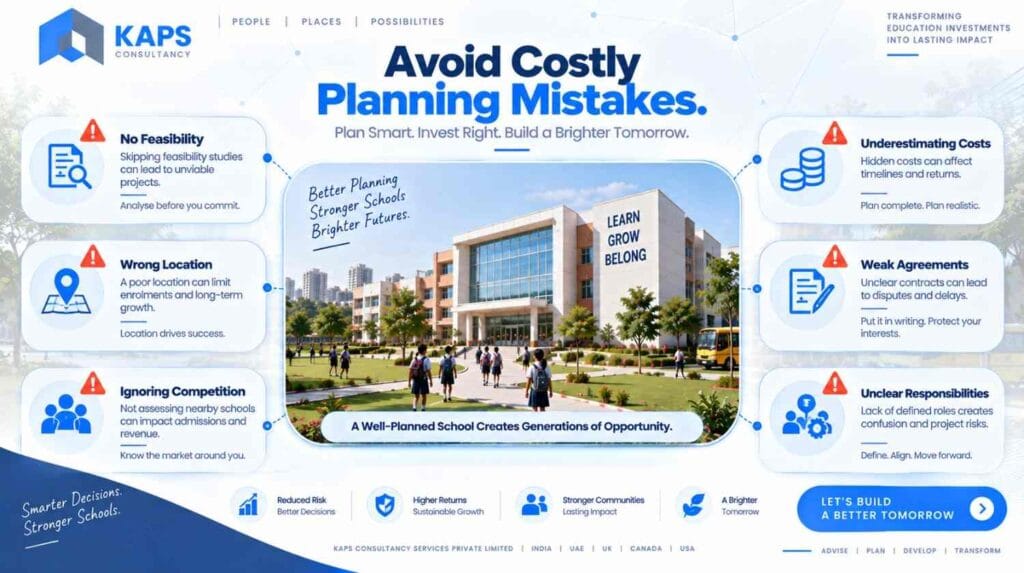
Committing land without feasibility analysis
A property may appear ideal but still have limitations related to access, land use, demand, competition, or development.
Choosing a location only because land is available
Availability is not the same as market suitability.
Ignoring surrounding schools
Existing schools provide important information about demand, competition, fee positioning, and market expectations.
Underestimating development and working capital
Construction is only part of the financial requirement. Early-stage operations may also require substantial working capital.
Signing long-term agreements without reviewing terms
Lease duration, escalation, responsibilities, maintenance, development obligations, exit provisions, and default conditions should be reviewed carefully.
Failing to define partner responsibilities
Landowners, investors, education brands, and operators should have clearly documented responsibilities.
Focusing only on property value
A valuable property does not automatically make a viable school project.
How KAPS Consultancy Helps Landowners and Investors
KAPS Consultancy Services works across education expansion, leasing and asset utilisation, investment advisory, partnerships, school setup, mergers and acquisitions, and institutional growth.
For Landowners
Support can include:
- Land feasibility assessment
- School leasing solutions
- Educational asset utilisation
- Education partnerships
- Joint development opportunities
- Institutional development planning
For Investors
Support can include:
- Education investment advisory
- Project evaluation
- Market assessment
- School development planning
- Partnership opportunities
- School acquisition opportunities
- Institutional growth planning
The objective is to evaluate the opportunity first and then determine which development or investment structure fits the project.
Your Land Can Become Part of a Larger Legacy
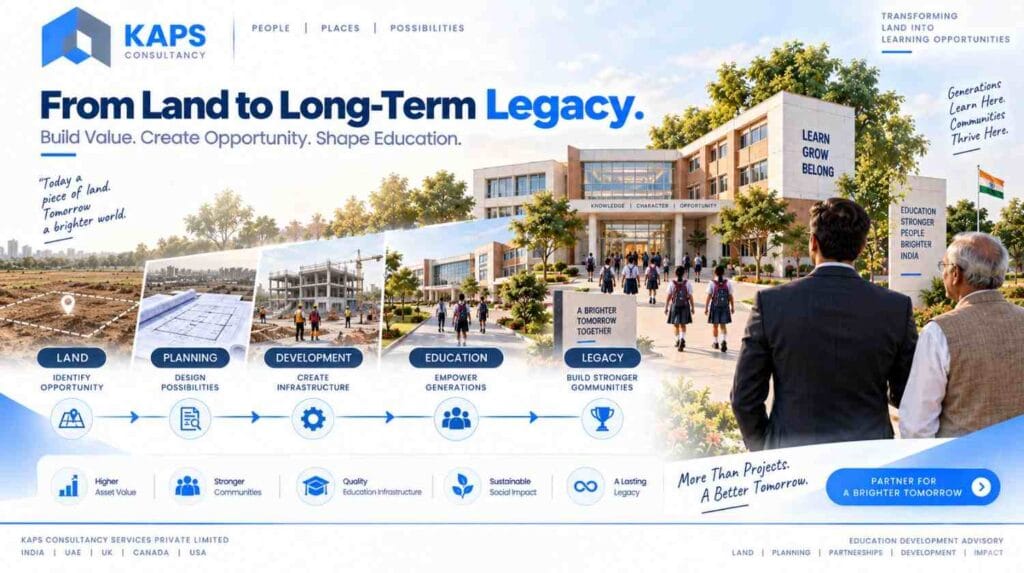
A piece of land can remain an asset on paper. With the right planning, partnership, and development structure, it may become part of an institution that serves students and communities for many years.
For landowners, the decision may be about more than leasing or selling property. For investors, it may be about building an education project with a clear market, operating model, and long-term plan.
The right opportunity begins with the right questions.
Have land that could be suitable for an education project? Or are you exploring a school investment opportunity? Evaluate the land, market, development model, and investment structure before committing your property or capital.
Frequently Asked Questions
Land for school development in India refers to property that may be suitable for developing an educational institution after considering location, land size, accessibility, applicable land-use permissions, market demand, infrastructure requirements, and relevant regulatory conditions.
A landowner can explore a structured lease with an eligible education operator or institution after evaluating the property’s legal status, suitability, commercial terms, development requirements, lease tenure, responsibilities, and applicable regulations.
Potential school investment models include greenfield school development, existing-school acquisition, franchise or brand partnerships, landowner-investor partnerships, and other structured education projects. Each opportunity requires separate feasibility and financial evaluation.
Evaluate location, road access, residential catchment, population growth, competition, land title, land-use permissions, infrastructure feasibility, applicable school-board requirements, and future expansion potential.
Yes, a project can be structured around a landowner contributing suitable property while an investor contributes capital. The exact structure depends on the project’s feasibility, legal framework, investment requirements, responsibilities, and commercial agreement.
Investors should assess market demand, student catchment, competition, development costs, working capital, regulatory requirements, operating capability, admissions strategy, financial assumptions, and long-term expansion potential.
Feasibility helps determine whether the proposed location, land, market, financial structure, and operating model are suitable before significant capital or property commitments are made.
KAPS Consultancy provides services related to school expansion, leasing and asset utilisation, education investment advisory, school setup, partnerships, mergers and acquisitions, and institutional growth planning.